 BMW Sauber finished in sixth place in the constructors' world championship German car manufacturer BMW has provisionally agreed to sell its BMW Sauber Formula 1 team back to team founder Peter Sauber. The move comes after BMW cancelled plans to sell to Qadbank Investments. Sauber, who retained a 20% stake in the team when he sold it to BMW in 2005, will take complete control if they are allowed to race next season. The team is not guaranteed a place on the 2010 grid because they failed to sign the Concorde Agreement in July. BMW Sauber lost their guaranteed place on the grid to Lotus, however, Toyota's decision to leave F1 earlier this month has opened up a space on the grid. The sport's governing body, the FIA, is yet to confirm the team as the 13th entry for next season - the official entry list will be published on Monday, 30 November - but it is likely that Sauber's entry will be accepted given its history and reputation in the sport. But 66-year-old Sauber, who entered F1 with his team in 1993, said: "I am convinced that the new team has a very good future in F1, whose current transformation with new framework conditions will benefit the private teams. "It also means we can keep the Hinwil location and the majority of workplaces." BMW board member Klaus Draeger said: "We are happy with this solution. "Our relationship with Peter Sauber has always been excellent and marked by absolute respect." | |
Friday, November 27, 2009
BMW sells Sauber back to founder

Thursday, July 30, 2009
What does BMW's exit mean for F1?
BMW has confirmed that this will be its last season in Formula 1.
The team, 
But that's only part of the story.
Like Honda, which pulled out of Formula 1 before the season had even started, the German carmaker has seen its sales and profits tumble as a result of the global economic downturn.
In such a difficult environment, they are struggling to justify spending hundreds of millions of dollars a year on motor sport.
BMW's departure leaves four car manufacturers still competing in F1: Ferrari, Mercedes Benz, Toyota and Renault.
Ferrari is unlikely to leave the sport, because its image as a manufacturer of supercars is intimately tied to its racing heritage.
But there is widespread speculation that at least one of the other major brands could follow BMW out of the door.
"BMW definitely won't be the last," says F1 analyst Christian Sylt of Formula Money.
"Before the end of the year, we will see at least one other car manufacturer leave F1."
According to motorsport's governing body, the FIA, such an exodus was inevitable.
"It has been clear for some time that motorsport cannot ignore the world economic crisis," it said in a statement released after BMW's announcement.
"Car manufacturers cannot be expected to continue to pour large sums of money into Formula 1 when their survival depends on redundancies, plant closures and the support of the taxpayer."
Race against time
So will BMW's departure cause any lasting damage to Formula 1?
 Ferrari is not expected to pull out of F1 - but at least one other firm is |
The answer is, not necessarily.
Three new teams are due to join the series next year. Assuming they can raise enough sponsorship to guarantee their entries, there should still be plenty of cars on the starting grid.
But in the current climate raising the money is likely to prove difficult.
In addition, the new teams face a race against time if they are to be on the grid next year.
If the new entries fail to materialise, and more teams leave, a crisis could yet develop.
Some experts believe that the departure of major names such as Honda and BMW undermines F1's claim to be the pinnacle of world motorsport.
It's an argument that points towards the real problem facing Formula 1.
Spending rows
A key part of the sport's attraction is its brash, free-spending image.
It oozes high-rent glamour, and promotes itself as a hub of white-hot technology.
 There have been moves to reduce spending in the glamorous world of F1 |
That image comes at a cost. In recent years, top teams have been spending more than $400m (£244m) a season.
Yet as the departures of BMW and Honda have illustrated all too clearly, that kind of outlay can no longer be taken for granted.
For much of the past year, the main stakeholders in Formula 1 have been embroiled in a bitter dispute over how to cut costs, without emasculating the sport.
The FIA, led by its forceful president Max Mosley, wanted to put the brakes on spending by forcing teams to cut their budgets to just $60 million a year, as well as restricting technical development.
But this was vehemently opposed by most of the teams, who believed such a move would destroy the essence of Formula 1.
'Nuclear' threat
The teams' ire was also directed at the Formula 1 Group, the network of companies run by Bernie Ecclestone, which control the commercial side of F1.
The group earns close to a billion dollars a year from trackside advertising, television rights and race fees.
But only half of the money goes back into F1, as payments to the teams.
The rest is absorbed by the F1 Group and its ultimate owner, the private equity group CVC Capital partners.
At a time when sponsors were hard to find, the teams argued, they should be given a bigger slice of the cake.
The dispute came to a head at the British Grand Prix in June, when eight teams threatened to walk out of F1 and set up their own rival championship.
That plan, widely seen as a "nuclear option" now looks highly unlikely to be carried out.
Under intense pressure from Bernie Ecclestone and the F1 Group as well as the team owners, the FIA backed down.
Saturday, July 25, 2009
The BMW F1 09: The Big Blunder
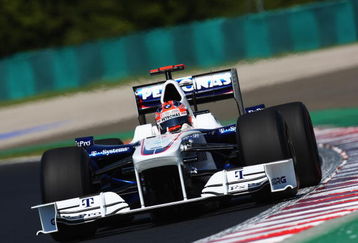
Last season BMW Sauber driver Robert Kubica was in the mix for the F1 World Championship right up until the last few races of the campaign.
The title ultimately went to Lewis Hamilton, after a last minute win at the Brazilian Grand Prix, which broke local hero Felipe Massa's heart.
One of the reasons why Kubica was not given the opportunity to chase the 2008 World Championship was because the BMW Motorsport hierarchy decided to concentrate the efforts of the team on the construction of the BMW F1 09.
A decision that, with hindsight, was an extremely bad one.
So far this season BMW have struggled at the back of the grid constantly.
Although all Formula 1’s heavy weights have struggled with the raft of technical regulations brought in at the beginning of the season, Ferrari and McLaren have continued to try to upgrade their cars to give their drivers the best chance of doing well.
BMW seem to have written off 2009 just as they wrote off 2008.
Today, at qualifying for the Hungarian Grand Prix, both Robert Kubica and Nick Heidfeld failed to make the second session and will start tomorrow's race from 16th and 19th place on the grid.
BMW are a classic example of thinking too far forward. They planned too far ahead and have paid the price for not considering every factor.
This season will have been a big lesson for them.
Because of their decision to concentrate on 2009 in 2008, they failed to win anything and now with 2009 pretty much a write off as well they will soon be planning for 2010.
BMW spent too much time on technology that did not live up to the hype made, namely KERS.
In a time of global recession, which has hit car manufacturers badly, the likes of BMW will have been left counting the pennies and dreaming of what might have been.


